To follow our progress on google maps via Pavinski Traveller, click here: http://pavinski-travel.blogspot.ca/

Thursday, September 19, 2013

Pasto

Pasto. Population 400K, elevation 2551m. A nice enough town, Pasto is the usual jumping-off point for people travelling through to Ecuador. I say “usual” because while it’s only a 2-hr drive to the border, it’s still 2 days away for us. We get to enjoy Colombia for a few more days!

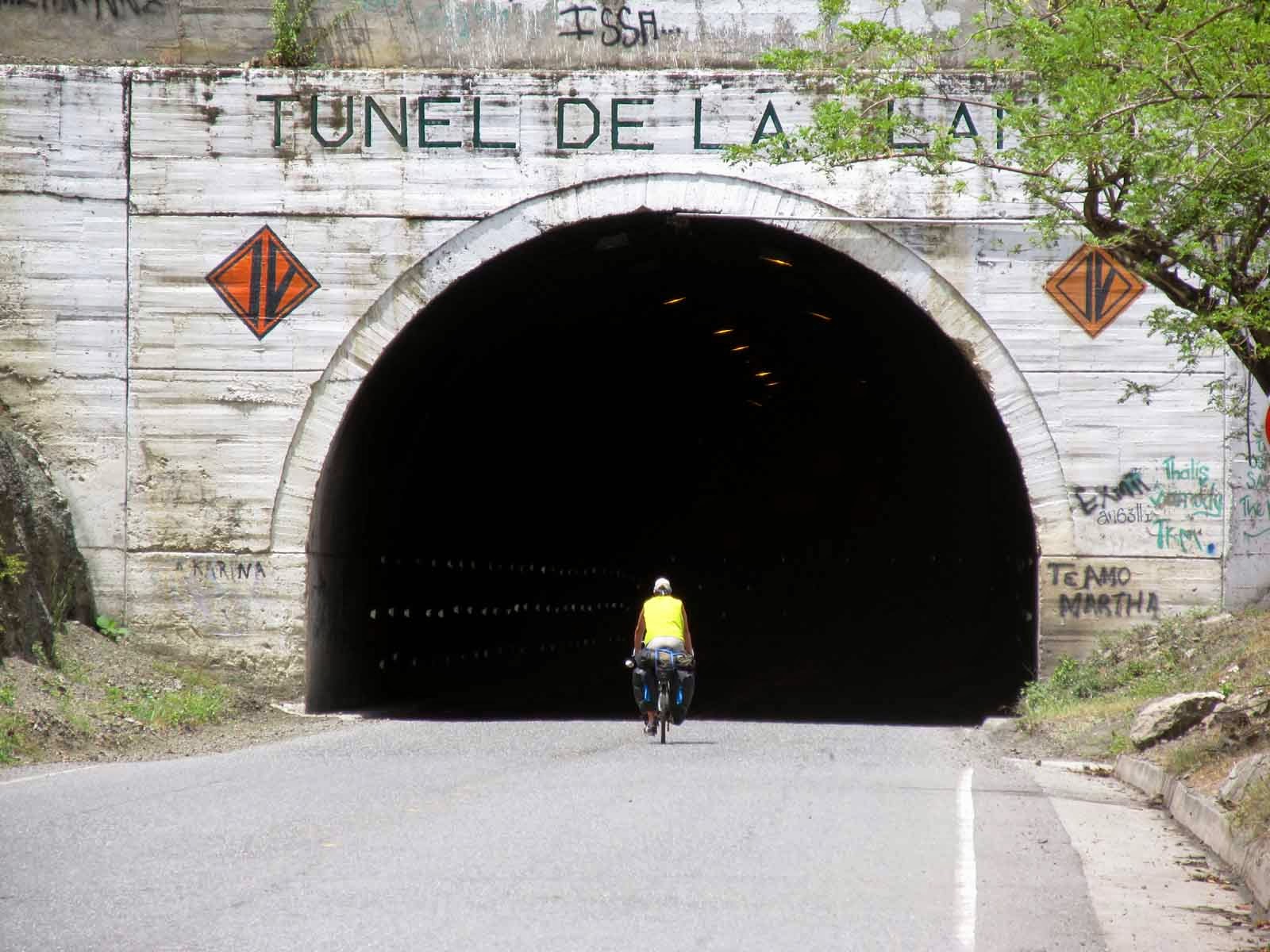
The route from Popayan has begun to reveal the true nature of the Andes. We have transitioned from the semi-tropical mid-elevations (1000 to 2500 m) of Colombia, to the drier (cactus dry) and higher elevations (2000 to 4000 m) of Ecuador. The mountains have grown dramatically and become more spectacular and awe inspiring. We are feeling smaller and smaller as the terrain dwarfs all signs of humanity. The road ahead is starting to look like a goat trail snaking through the mountains. We even hit our first tunnel carved out of the middle of nowhere. And, of course, bigger mountains means bigger climbs. That previous 500-m daily vertical goalpost we set for ourselves has now been pushed to 1000+ m. Looking at the elevation profiles for what is to come, even that means multi-day climbs.

Yesterday was one of those days. The final approach into Pasto started with a 1000-m warm-up climb, followed by a 700-m descent, and a nice little finishing climb of 2000 m. Our original plan was to split up the second climb and find a place to stay somewhere in the middle. After completing the warm-up climb and descent, and about 400 m into the second climb, with nowhere to stay (or even eat) in sight, Amy’s batteries were bottoming out. Things were not looking cheery, and unbeknownst to Amy, I was starting to fear we might be spending the night on the side of the mountain somewhere. But as usual, things worked themselves out, and an opportunity we could not pass up revealed itself. An empty truck with a very generous Colombian driver stopped and offered us a ride. No doubt tipped off to our situation by the sight of Amy curled up and passed out on a piece of concrete beside the road, and me circling the perimeter looking for signs of life in the distance. Et voila, 1 hour later we were sitting pretty in the Hotel Koala in Pasto’s el centro. What a difference an hour makes. That last 40 kms would have taken us 2 days.
 

Pasto, as mentioned, is a decent place and nice stopover for us – a Colombian city, not a gringo in sight. Lots of great little cafes, huge colonial-era churches on every second corner, and, surprisingly good pizza (very rare so far). We’re also in volcano country. But unfortunately Volcan Galeras, the 4267-m active volcano serving as the city’s backdrop is covered in cloud and invisble on this blustery fall-like day (Amy’s down jacket has appeared from the depths of her panniers). Only 8 km from el centro, and Columbia’s most active volcano, Galeras poses a serious risk to the town. In 1993, 9 volcano scientists were killed while hiking within the crater as it erupted. Since then there have been numerous eruptions and multiple evacuations. Hopefully it won’t pick today or tomorrow to go off again.
 

So today is a rest day to check out the local sights, eat more street food (Amy’s new street food fav: fresh hand-made potato chips), and hang out in the palatial Koala Inn – a very hostel-like old colonial building complete with ridiculously high ceilings, a spacious interior courtyard lounge, 10-foot French doors, and creaky wooden floors and stairs. This morning, Louis (manager) treated us to his famous “best pancakes in town” breakfast. Amy’s favourite breakfast by a long shot thus far (tons of fruit, and topped with fresh local honey), we would have to say he could change his ad to “best pancake breakfast in Colombia”.  Well, OK, so far the only pancake breakfast we have encountered in Colombia, but it was a good one!

Tomorrow we continue the push. The 82-km route to Ipiales (the real border town) starts with a 600-m warm-up climb, followed by a 1500-m descent, then a finishing climb of 1100 m. Our plan is to find a well-placed town along the way to split that up into 2 days. We’ll see how it goes. With any luck, the next post could be from Ecuador. Hasta luego.


The first tunnel on the road to Ecuador (that little white thing in the middle of the photo)


Sunday, September 15, 2013

Popayan


Popayan, La Ciudad Blanca (the white city). And white it is! The old city here consists of an el centro district lined with old colonial buildings uniformly whitewashed with chalk-white facades. Second only to Cartagena (well, officially anyway) as Columbia’s most impressive colonial city, Popayan might just be a nicer place to visit due to the mild climate and more “off the beaten track” location. While there are a few gringos at our hostel, we are the lone representatives on the streets. It just doesn’t have that touristy vibe that Cartagena has. And, at 1760 m, the climate is near perfect. Nice warm days, followed by cool nights – 365 days a year. We’re still getting our heads around the lack of seasons here.

The two-day ride (150 kms) from Cali went smoothly, with a bit of a grind on the second day due to undulating ups and downs. We’re still learning the subtleties of what an elevation profile looks like and how it translates to the actual ride. My tendency had been to look only at the net elevation gain between the low and the high for the day, but that changed on this ride. Day two totalled a net gain of about 500 m – which has now become a daily goal post on the larger climbs – but also included half a dozen rollers of 100 m or so. Those rollers kill you. They definitely add to the total climb for the day, and turn a 500 m climb into a 1000 m climb. Lesson learned.

We’ve been remarkably lucky with rain. As mentioned in previous posts, it rains every day (i.e., every 24 hrs). But thus far, we have escaped riding in the rain except for one 10-minute sprinkling the other day. Yesterday, we watched from the luxury of our lovely colonial-style room adjacent to the cathedral and overlooking the main square (could be the best room yet), as a massive storm swept through the city. Gail-force winds and torrential downpour for about an hour. We both looked at each other and didn’t have to say it “what if we were riding right now?”  Yikes! But from the security of our bay window it was a great show.

 An interesting, if not disgusting, event occurred on our overnight in between Cali and Popayan. As mentioned, one of the pros of cycle touring is that we are forced to overnight in the middle of nowhere in the “real” Columbia. One of the cons however, is that we are forced to overnight in the middle of nowhere in the “real” Columbia. On said night, we reluctantly accepted accommodation at a less-than-sterile location. Not realizing the full severity of our decision until the next day, we were fully informed as I discovered multiple cockroaches crawling out of my handlebar bag and up my hands as we rode out of town. The final count after going through all of our things to shake out the lovely little critters, was dozens. Amy, who now has a near-fatal case of the heebeegeebees has chronicled the event for those interested in the gory details: http://wheelnspoke.blogspot.ca/.  Suffice it to say, not a pleasant experience, but no harm done either. As they say, what doesn’t kill you makes you stronger. All part of the fun!

 Another interesting event, actually more of a realization, was our need to switch accommodation here in Popayan due to a group of young partying Colombians sharing our space. From what we have gathered thus far, Colombians (perhaps all Latin Americans) seem to have an infinite tolerance for noise, or I should say, an infinite ability to create it. No matter where, or when, or in what situation, there doesn’t seem to be any inter-personal boundaries to noise. Walking into a hotel or hostel at 3 am and turning on all electronic devices in a room and engaging in a spirited conversation about the night’s events seems entirely acceptable regardless of the proximity to other people. Similarly, any amount of shouting, yelling, music, vehicle horns, and/or any other kinds of loud noise at any time of day or night, appears to be entirely normal to everyone involved regardless of the situation. Needless to say, getting a reasonably peaceful sleep has become a top priority and challenge for us – it’s never entirely quiet, but sometimes it’s at least reasonable. Interesting facet of life here.

 Taking a couple of days off to walk the lovely streets of Popayan has been our recent agenda. The good food, including a local specialty of peanut-sauce empendas, has been a nice treat. Tomorrow we hit the road again with our sights on Pasto, the last of the big towns in Columbia. There is, of course, the ubiquitous large descent followed by the large climb to deal with. By our calculations it should take 4 days to cover the 250 kms. Hopefully cockroach free! With Pasto under our belts, we will be within striking distance of Ecuador, and onto the next phase of the adventure. I believe Ecuador is quite flat...no? J
 

Wednesday, September 11, 2013

Cali

Almost a record day yesterday, but not quite.  143 kms. Our previous record of 144 kms in a day was set in Cuba and still holds. As expected, and a very pleasant change of pace, the 233 kms ride from Salento began with a 1000 m descent – mostly coasting which was fun! – followed by about 150 kms of flats. What a difference. It felt like we were floating. Just the hum of rubber on pavement. I love that sound. It’s the sound of effortless progress. The progress is made easier by the abundance of great pavement in this country. We are both amazed at the quality of roads in Colombia. Most of the time we’re enjoying the luxury of sharing a nice wide paved shoulder with the odd horse cart or broken down motorbike. We assume the obvious reason for such high quality pavement is the frequency of toll stations (aka peaje), which we are delighted to report are free for cyclists. We even get our own lane!

We didn’t plan on a big day yesterday, it just worked out that way. As the afternoon passed, and we didn’t find anywhere to stay for the night (or I should say, anywhere acceptable to us...we were being fussy since the riding was easy), all of a sudden we were seeing signs for Cali and decided we might as well just ride it out. As an incentive, we knew there was a hostel with a pool with our name on it in Cali. Helped by a relatively easy city to navigate and surprisingly reasonable rush-hour traffic, we made it to the El Viajera (trans: “the traveler”) hostel in time for a couple of poolside cervezas. It was a good decision.

Leaving the zona cafetera behind us, we have entered the flatter and hotter lowlands of Cali. Although, what we gave up in topography we also gave up in scenery. We are firmly back in the land of endless sugar cane fields, and of course, hotter temps. Elevation is everything here in terms of temps. At 1000 m, Cali is hot. Not Cartegena hot though with it’s 100% humidity. And, it cools off at night in Cali, which makes for good sleeping. All in all, a pretty decent climate, and probably the reason why there’s a city of 3.5 million here.

We aren’t here for the long term, just a stopover. Not much to report in terms of what Cali looks like, since we aren’t planning on any serious sightseeing. Today is a rest day to refuel, relax beside the pool, take advantage of the free yoga, and, of course, the free salsa lessons. Cali is, after all, the salsa capital of the world. In fact, it seems that many of the travelers here are here specifically to take salsa lessons and take in the salsa club scene. By all accounts, it’s a very happening scene. First sign we saw on the way into the hostel was “salsa party tonight at Siboney’s [a local salsa club]: 8 pm till dawn”. Since 8 pm is about our bed time, we took a pass on that one.  We might be able to squeeze in the 7 pm lesson, provided it doesn’t go too long J


Tomorrow the drive continues south towards the city of Popayan – reported to be a very charming colonial city and UNESCO world heritage site know for it’s food (perplexing given the lack of gastronomical adventures so far in Columbia). We’re both looking forward to that. As referred to previously, what goes down must come back up here in the Andes (you just have to learn to put that out of your mind as you whiz downhill). The next few days involves a nice little climb (crawl) back up into the mountains. We can feel that mountain air already. More soon.


Sunday, September 8, 2013

Salento

I love small towns. Everything is easy. The access, finding a place to stay (or sometimes the place to stay), walking around....it’s just easy. And mostly, it’s real. Cities have their own attractions, but the real Colombia is in the small towns. Salento: population 4000, elevation 2000 m, smack in the middle of the zona cafetera, and with that perfect mix of cafes and old guys sporting ponchos and machetes. Like Nelson, it’s just far enough off the beaten track to keep it real, but close enough that you can get to it and enjoy the comforts of civilization (good coffee, at last!).

The ride from Pereira to Salento was pretty tame. Either we’re becoming immune to the climbs or getting better at managing them, or both, but we both commented on the fact that upon arrival a couple days ago we didn’t instantly collapse onto the bed as we usually do. So hey, we might just be able to complete this mission after all (had our doubts there for a while). One step at a time though, Boliva is in front of us (yikes!). We’ll have this conversation again in a few months from now when we’re at 4000 m.

It was a big night in town when we arrived; actually all over Columbia. Columbia advanced itself in a pivotal FIFA World Cup qualifier game against Ecuador. I don’t think it’s news to anyone that soccor (aka futbol) is beyond huge here and elsewhere throughout South America. And, given the shared border, Columbia and Ecuador are huge rivals. The game was in Barranquilla, a city on the coast we cycled through a few weeks ago. We knew about the game from my now daily browsing of “Columbia Reports”, an on-line English-language newspaper. It was really cool to see everyone everywhere getting pumped for the game. The bright yellow team-Columbia jerseys were everywhere all day long during our ride. Riding through Salento’s el centro in the early afternoon we could see them propping up the beer tents and flat-screen TVs for the 3:30 pm start. It was pandemonium in the square when the final whistle blew leaving Columbia with a 1-0 win over Ecuador – almost as loud at it would be with a Toronto win over Montreal for the Stanley cup J

 Today we walked through our rite of passage as Colombian travelers and took the quintessential coffee tour, lead by Juan Valdez himself (his name is Don Elias, but he could have been Juan Valdez). It was a wonderful stroll down the mountain from town to Senor Elias’s organic coffee farm, followed by an in-depth explanation of everything coffee. There was the minor issue that Senor Elias doesn’t speak a word of English, but we managed, and we think we understood the majority of what he was telling us. At the end of it all, while sipping on a cup of his fine brew, we didn’t have the heart to tell him that we couldn’t buy a pack of coffee from him because we don’t want to carry it on our bikes (and, I couldn’t think of how to explain that in my gringo Spanish), so we bought a pack of coffee off him to take back to our hostel. Free coffee this afternoon at the Tralala Hostel in Salento!

For those of you keeping track, I believe we’re at the second key trip milestone (see previous “made it” post): everything has become normal. It’s one of those critical moments in a long trip where you just feel at home. Arepas, empendas, plato typico, aguila, buenos dias ...all normal now. Even the blarring latino top-40. Probably couldn’t get to sleep without it now (ok, that’s a lie, but you get the point). Amy even has a favourite beer now: Redd’s dry – not the regular one, the “dry”.

 Salento. Pretty much your iconic Colombian coffee mountain town. We’ve been living the good life of a fantastic hostel, slow mornings, daily walks around town, coffee tours, and evening sunsets over the mountains. If we didn’t have another 10,000 kms or so to cover, we would probably just stay here. But alas, the road calls. We must advance the troops. Tomorrow we ride for Cali, the big city of, and apparently, salsa capital of the world (the dance, not the stuff we put on nachos). According to the elevation profile, we go down, way down, for about 200 kms right into Cali. We’re both pretty stoked about that and what should be an easy few days of riding – perhaps even coasting! Although, what goes down has to come back up around here....but we won’t think about that for now. See you in Cali.


Thursday, September 5, 2013

In search of a good cup of coffee


 Just a quick post here to relay a good story. You would think it an easy task to find a good cup of coffee in the middle of Colombia’s central coffee zone. But no, not easy. As mentioned previously, the coffee industry here is intended for the export market, and most Colombians aren’t huge coffee buffs. The result is that coffee on the street, and most establishments, is lacking.

So Amy eludes to this conundrum on Facebook this morning. As luck would have it, and unbeknownst to us, a Nelson friend of ours, Greg Munby, spent 2 years teaching here in Pereira (where we are staying at the moment) some time ago. Via the magic of Facebook, Greg informed of us where to get the best coffee in town: El Templo Del Cafe in el centro. A quick google search and we were charting a course to El Templo within minutes. A brief stroll through the streets of Pereira found us sitting in El Templo and indeed, enjoying a fine cup of Colombian espresso topped up with foamed milk, just the way we like it. It was a fine brew. The best so far!

 Thanks Mumbai!
 

Wednesday, September 4, 2013

Zona Cafetera

Nestled in the lush mountains of central Colombia, is one of the world’s great sources of coffee: Colombia’s zona cafetera, or “coffee zone”. Traditionally second only to Brazil in terms of coffee production, Colombia has recently slipped to third behind Vietnam. However, Colombia is the world’s largest producer of Arabica beans (arguably the best bean), which is the only bean grown here. Ironically, Colombians aren’t huge coffee buffs, especially outside of the coffee zone. The vast majority of beans cultivated here are exported to gourmet coffee shops around the world. As a result, the classic cup of tinto on the street in Colombia is just plain bad by world standards, and don’t be surprised if it’s instant (yes, instant!). The coffee seems to have improved since arriving in la zona, but it still isn’t anywhere near what coffee snobs would call “good”. Kinda weird being in the middle of one of the world’s great coffee zones sipping on a cup of instant coffee.

Leaving Medellin we were dreading having to negotiate the urban traffic congestion generated by 3 million people. However, we were very pleasantly surprised to learn that we randomly picked Sunday to leave the big smoke, which is the day that Medellin shuts down one side of the autopista (Medellin’s 401) and turns it into one huge bike lane stretching from one end of the city to the other. Wow, what a delightful stressfree ride out the city and back into the mountains. It was really special to see the hundreds and thousands of city folks out on their bikes enjoying the day. As we suspected, Colombians take their cycling seriously and more than one pack of “Tour-de-Francers” whizzed by giving us the thumbs up.

The ride from Medellin has been very revealing on several fronts. Mostly we realize that we are simply going to have to downgrade our expectations for how many kms we will bank in a day. On previous trips where topography really wasn’t part of the equation, 75 or 80 kms was a decent day, with 100 or more a really good day, and 50 or less a very short day. Here in the Andes, if we get 50 kms down the road, that’s a good day.  70+ kms, we are ecstatic, and classify that as an exceptional day. 30 kms is more than enough if it includes a big climb.

So ya, climbs.  Our thinking on that has also evolved. Huge climbs of 1000 to 2000+ m are part of the scenery here. Any two major destinations are going to involve not just one, but several large climbs. If we don’t learn to love them, it’s over. For those of you from the Koots, the terrain here is almost identical and can be described as steep interconnected 2000+ m ridgelines punctuated by steep valleys. Unlike the Koots though, where roads and humans generally follow valley bottoms, here people and paved roads (amazingly good paved roads) travel up, along, and over every ridge. Towns are at the top, as opposed to the bottoms. Cycle touring here is like doing a ski traverse on your bike. Up one ridge, down the next. Very cool once you get that in your head. The added bonus is that towns and facilities seem to be distributed across the landscape with cycle touring in mind. They seem to be perfected scattered at just the right distance so that there is no need to carry food, extra water, or ever be stuck for a place to sleep. Seems like there is an endless supply of cheap hotels exactly where we want them.

Of towns and cheap hotels. This is one of the true jewels of cycle touring. Because we must stop for the night in the middle of nowhere, we stay where no gringo has ever stayed before (at least judging from the reaction we get from the locals). Unlike bussing which takes you from one gringolandia (place where gringo tourists congregate) to another, we spend most of our time in places that never make it into any travel guide. Now, hostels and the associated draws in gringolandia are fun and make for a good change of pace. But for us, it’s the unnamed places, people, and random encounters in between that are the real draw. As someone once said, the best part of a good trip is the journey, not the destination. Nothing is more true of cycle touring.

So where are we are we at the moment? For those looking at maps, we decided to bypass Manizales because upon closer inspection of the route, it involved a 1200 m climb followed by a 1200 m descent back to the same main highway.  Not a good use of our limited energy. We therefore continued onto Pereira, heart of the coffee zone, and are now enjoying the comforts of the Kolibra Hostel. We’re looking forward to the free coffee in the morning, but haven’t set our expectations too high. I asked the guy if they had milk for the coffee (rare here), and he looked at me sideways...hmmm, not a good sign. The plan is to take a day off tomorrow, lie in a hammock and let our legs and butts recoup a bit, then pack up and head towards (climb actually) a small mountain town called Salento known for its views and, wait for it, coffee. Looking forward to that. See you then.  
Elevation profile: Chinchina to Salento (our next stretch).